
SBTi 2.0: A new level of ambition
By Kelly Flatz, Senior Sustainability Consultant, Oxygen Consulting
Published July 2026
The latest version of the Corporate Net-Zero Standard from the Science Based Targets initiative (SBTi) has been released, marking a significant shift in corporate emissions targets and transition planning expectations.
The Corporate Net-Zero Standard is arguably the most important and influential net-zero standard globally, with more than 11,000 companies currently having approved targets in place (as at June 2026). Asia has also been leading recent growth in targets, underscoring the continued focus on climate strategy around the world and the frontiers of climate action increasingly shifting towards Asia and emerging markets. While New Zealand has a limited number of companies with approved net-zero targets, the SBTi and its near-term and net-zero target pathways have been central to modelling and setting emissions reduction targets for businesses and in emissions certification programmes here.
Version 2 of the Corporate Net-Zero Standard represents a major revision of the previous standard, from the way the criteria are presented and structured to what is now required of companies, particularly larger ones. A high-level summary of the key changes is included below:
Transitioning from a separate SME target-setting route to formal company categorisation (Category A and B) with differentiated requirements based on a company’s category
Formalisation of SBTi’s Assurance Model to support the assessment of continuous improvement
Introduction of net-zero governance and transition planning requirements
Expanded target setting options across scope 1, 2 and 3 that reflect different contexts, available levers, and best-efforts
Optional ongoing emissions responsibility framework to support the development of carbon markets
Expanded criteria for the neutralisation of residual emissions and a forward-looking requirement to support carbon removals from 2035 onwards
For New Zealand businesses, I have also summarised some of the most material updates for our context:
1. Small companies do not have to address scope 3 emissions
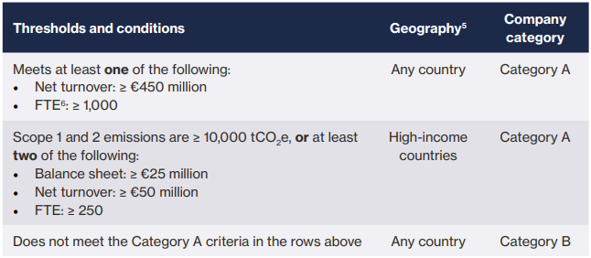
Currently, companies defined as an SME have the option to set near-term targets on scope 1 and 2 only, but must commit to measuring and reducing scope 3. V2 of the Corporate Standard now introduces formal company categorisation under the one standard: Category A and Category B.
Category A comprises large companies from all countries and medium-sized companies from high-income countries, while Category B comprises small companies from all countries and medium-sized companies from lower-income countries, as defined by revenue and other criteria. Based on these criteria, many New Zealand businesses will fall into Category B.
While Category A companies will be required to meet all mandatory requirements, Category B companies will be exempt from certain requirements, including to measure and set scope 3 targets. This is a marked shift in the expectation of New Zealand businesses today.
2. Transition plans required are now required
To ensure all targets are credible, all companies will now be required to have a transition plan in place that is embedded in company strategy and covers each of a company’s targets. For example, Category A companies are required to cover scope 1-3 targets and Category B companies that have only set near-term targets for scopes 1 and 2 are only required to cover those targets. While all companies are required to have a transition plan in place, only Category A companies will be required to disclose this publicly.
The SBTi has recommended that companies develop transition plans in line with international standards such as the Transition Plan Taskforce Disclosure Framework, supporting continued momentum towards a single, globally consistent transition plan standard.
3. Emissions inventory requirements are now clearer
SBTi continues to align itself closely with the GHG Protocol Standards, and all GHG inventories must be prepared in accordance with these standards. Category A and Category B companies must measure scope 1 and scope 2 emissions, and Category A companies must also report scope 3 emissions and obtain assurance.
Companies with FLAG emissions, bioenergy emissions, and biogenic and technological removals must also measure these in line with the GHG Protocol Land Sector and Removals Standard. Given that this standard is also very new, companies that need to measure land sector emissions and removals will be expected to navigate two new standards at the same time.
Companies will be specifically required to prepare a physical GHG inventory first and foremost. A physical inventory allocates emissions based on physical relationships and the physical flows of goods and services to the company. This therefore means using the location-based method for scope 2 accounting.
Where applicable, companies can also separately account for and report their actions and market instruments. The Standard also introduces an actions and market instruments integrity criterion to ensure these support credible, high-integrity outcomes that reflect real-world emissions reductions and support system-wide decarbonisation.
As the GHG Protocol Standards themselves are currently undergoing revisions and will be published following the SBTi’s Standard, it will be important for all companies to keep a close watch on these changes and any implications this will have on their target setting.
4. You know scopes, now meet emissions-intensive activities
The new Standard introduces the concept of emissions-intensive activities (EIAs). Separate from scope 3 categories, EIAs are the most significant drivers to global GHG emissions, and include cement, steel, plastics, and aviation, for example. The SBTi is requiring Category A companies to identify and quantify these emissions specifically to ensure these are visible and properly accounted for to give companies a clear lever to target and reduce these emission sources.
Category A companies are required to measure emissions-intensive activities if they represent 5% or more of scope 3 emissions (excl. Category 15).
5. More target options!
The revised Standard provides a range of target options for each scope and emissions-intensive activity that companies can choose from. The SBTi has designed this to make the Standard more flexible for companies and allows for focus to go towards significant and intensive emissions.
Under the first version of the Standard, targets are based solely on the GHG Protocol Standards architecture where market-based accounting is excluded beyond scope 2. While the revised Standard has retained the physical inventory as the foundation to target-setting, the Standard also recognises that companies often need to use a wide range of strategies in the near-term to drive decarbonisation in the long-term, both within and beyond their operations and value chain.
Companies will be expected to focus first on direct decarbonisation within their operations and value chains. This includes actions such as reducing energy consumption, electrifying assets, installing on-site renewables, switching to lower-emissions products or suppliers, and changing business models to reduce emissions.
Scope 1
Scope 1 absolute emissions reduction: Targets to reduce absolute scope 1 emissions on a linear trajectory to residual levels by 2050 at the latest.
Scope 1 emissions intensity reduction: Targets to reduce scope 1 emissions intensity from applicable sector activities to reach residual levels by 2050 at the latest.
Asset transition targets: Targets to reduce scope 1 emissions in line with a trajectory defined by an Asset Decarbonization Plan. The plan shall set out a schedule to abate, retire, or decommission GHG-emitting assets in a manner consistent with reaching net-zero emissions by 2050 or earlier, using predetermined milestones (e.g., timeline to phase out investment in new GHG-emitting assets and operation of existing assets) and/or a carbon budget derived from one or more reference science-based pathways.
Scope 2
Under the previous version of the Standard, companies could set scope 2 emissions reduction targets against either their location-based or their market-based scope 2 emissions. Under the revised version, targets are anchored to the physical, location-based inventory, which is used as the basis for determining target ambition. However, while target ambition is aligned with the physical inventory, market-based actions are valid for demonstrating near-term target progress. A new criterion has been introduced to support credible and impactful market-based electricity procurement: near, new, and now.
Low-carbon electricity (LCE) alignment targets: Targets to increase the percentage of LCE used, contracted, or matched on a linear trajectory in line with an eligible net-zero pathway.
Scope 2 absolute emissions reduction (mandatory for Category A with high consumption growth): Targets to reduce scope 2 absolute emissions on a linear trajectory to a defined residual level that is consistent with an eligible net-zero pathway.
Scope 3
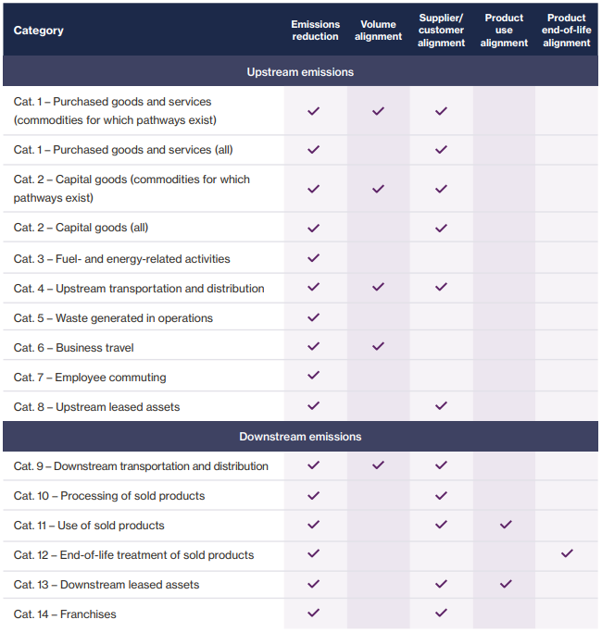
Near-term targets must cover at least all scope 3 categories that individually represent 5% or more of the scope 3 inventory (excl. Category 15). The SBTi will also allow complete exclusion of some emission sources, regardless of how big they are. These include, but are not limited to, all Category 7: Employee commuting emissions and Category 3: Fuel and energy-related activities emissions where they are already mitigated through reductions in energy consumption under scope 1 and 2.
Option 1: Overarching scope 3 absolute emissions reduction target: Target to reduce absolute scope 3 emissions on a linear trajectory to a defined residual level that is consistent with an eligible net-zero pathway.
Option 2: Overarching supplier and/or customer alignment target: Target to increase the share of tier 1 suppliers and/or customers (based on emissions, spend, or revenue) that are in transition or net-zero aligned.
Option 3: Category- or activity-specific targets: Targets applied to specific scope 3 categories or activities within categories (e.g., steel, cement, chemicals), individually or in combination. This option is for companies with concentrated emissions in certain scope 3 categories or from high-emitting activities, allowing for tailored target-setting options. It is designed to encourage the procurement of lower-carbon commodities and a gradual transition towards lower-carbon products and services. It differentiates between upstream emissions for which sector pathways exist (e.g., steel, cement, transport) and which companies may choose to use; all other upstream emissions; and downstream emissions. It offers tailored approaches to target setting for these three different groups, reflecting available mitigation levers.
6. Clearer expectation on removals
Companies will now be able to be recognised for their beyond value chain mitigation (BVCM) actions (now known as ongoing emissions responsibility) under an optional recognition framework. The framework recognises three tiers: Engaged, Advanced, and Leadership. While this change has been designed as a complement, not a substitute, for companies reducing their emissions, this does provide a legitimate basis for the use of high-integrity removals and climate contributions alongside target implementation which did not exist previously.
Post 2035, Category A companies will also be required to support eligible removals covering 1% of their ongoing emissions first in 2035, rising linearly to 100% by their net-zero target year. Eligible activities include carbon removal activities that deliver verified mitigation outcomes within the same reporting period as the covered emissions and meet specific integrity criteria. From 2035, companies will also need to support long-lived removals equal to at least 10% of covered emissions attributable to long-lived greenhouse gases.
Together, these changes represent a fundamental shift from the first version of the Standard, where BVCM sat mostly outside of the Standard requirements and removals were reserved for residual emissions neutralisation only.
For New Zealand businesses, the new Corporate Net-Zero Standard brings a mix of welcome relief and new expectations. Many will fall into Category B and step back from scope 3 target-setting and public transition plan disclosure, though embedded transition planning is now a baseline expectation for all.
Adding to the complexity, the underlying GHG Protocol Standards are themselves being revised and will be published after this Standard, so measurement and target-setting will need to keep pace with a landscape that is still evolving. The businesses that understand where they sit soonest will be best placed to build credible, future-proofed targets.
If you would like to talk through what the new Standard means for your business, please get in touch.