
The Land Sector and Removals Standard: What it means for your business
By Raedon Kane, Senior Sustainability Consultant, Oxygen Consulting
Published September 2026
If your business grows it, feeds it, processes it, or sells it, there's a new GHG Protocol standard that you need to know about.
The Land Sector and Removals Standard is the first standardised framework for accounting for land-based emissions and removals. Until now, companies making land sector claims and commitments had no common measurement basis. This Standard closes that gap, and it comes into effect on 1 January 2027.
The Standard applies across horticulture, arable and cropping, sheep and beef, dairy, and poultry, and it applies whether you're the one farming the land, processing what comes off it, or the one buying or selling it further down the supply chain. We've written this article to give you a practical, high-level view of what the Standard is, who it applies to, how the accounting behind it works, and what to do about it.
We’ve prepared this brief explainer on these new requirements.
About the Standard
The Standard was developed by the GHG Protocol's Independent Standards Board and sits as a supplement to the existing GHG Protocol Corporate Standard and Corporate Value Chain (Scope 3) Standard, rather than replacing either of them. Notable dates for the Standard include:
Approved: 1 October 2025
Published: 30 June 2026
Effective date: 1 January 2027
Next scheduled review: 2030
The effective date matters practically because it sets the first reporting period the Standard is meant to apply to, not a deadline by which you need to have everything figured out. With most of the work needed to comply with the Standard (traceability, supplier engagement, new data collection) taking more than one reporting cycle to build, organisations should start preparing now rather than later.
There are two documents to be aware of including the Standard itself, which is a relatively compact set of formal requirements and recommendations, and the supporting Guidance document, a much longer ~500-page document that provides the worked explanations, calculation methods, examples, case studies, and links to calculation tools and datasets that make the requirements usable in practice. Both are structured around the same twenty chapters (e.g., Chapter 7 in the Standard and Chapter 7 in the Guidance cover the same topic), just at different levels of detail. If you only read one document, read the Guidance. If you need to quote a specific requirement, the Standard is the citable source.
Does the Standard apply to you?
The Standard applies to any company with "significant" land sector activities in its operations or value chain, or that chooses to report carbon dioxide removals or geologic CO₂ storage. There's no fixed percentage that defines "significant" here (it's left to companies to determine), in much the same way SBTi leaves companies to assess their own FLAG exposure before applying its 20% rule of thumb for a dedicated target (see our recent piece on SBTi 2.0).
Two groups are squarely in scope:
Companies that own or control land (e.g., farmers, growers, and land-based producers of any size)
Companies that purchase, consume, process, or sell significant amounts of food, fibre, feed, or other agricultural products. This reaches well past the farm gate to processors, exporters, and food and beverage companies buying agricultural inputs
If your business does have significant land sector activity and you don't report against the Standard, you're expected to disclose that and explain why. Being in scope means the Standard's categories are relevant to your business and you're expected to have assessed them, even if the answer for a given category is genuinely "not material" or "not applicable."
What does the Standard cover?
Responding to the Standard does not involve a separate report sitting alongside your existing GHG emissions inventory. Land sector emissions and removals are considered across the Scope 1, 2, and 3 categories you're likely already using under the Corporate Standard and Scope 3 Standard, with the new chapters providing the specific accounting rules for categories that existing guidance either didn't cover or covered inconsistently. For example, land use change emissions from a purchased input sit within your existing purchased goods and services category.
The Standard sets out six emissions categories that are specific to land-based emissions and removals that should be considered in response to the Standard, including five compulsory and two voluntary categories.
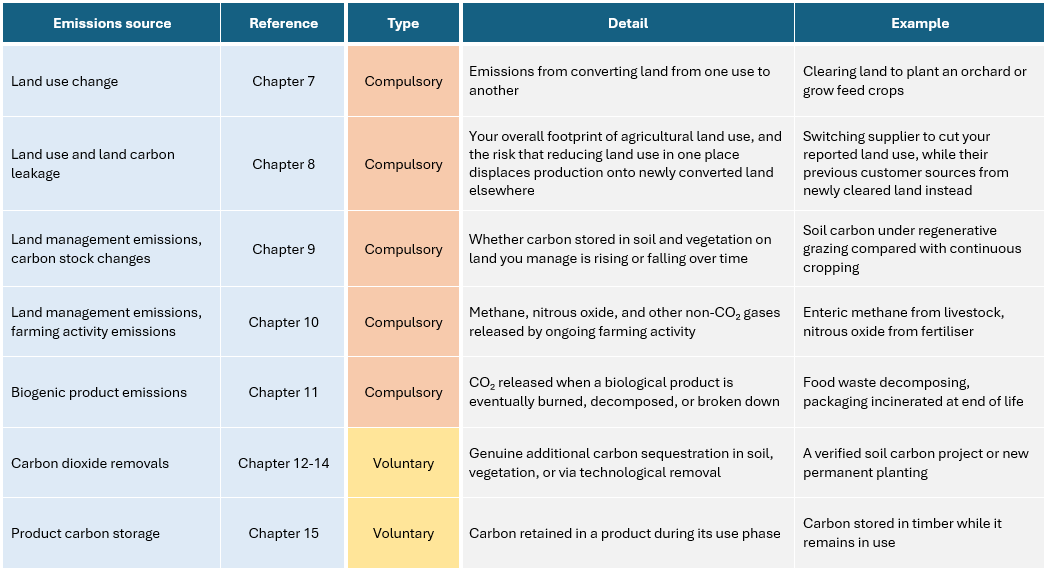
When considering these categories, there are two accounting principles that are important to understand as they explain why the categories are structured this way, including:
Emissions from land use change are one-off events (e.g., clearing land releases stored carbon at a point in time) but the Standard requires that one-off emission to be amortised, or spread, across a defined number of years after conversion rather than booked entirely in the year it happened. This is standard practice across land sector frameworks and mirrors how SBTi's FLAG guidance treats the same emissions.
Removals and gross emissions are always reported separately and never netted against each other. For example, a verified planting programme that removes 100 t CO2e doesn't reduce the reported gross GHG emissions figure by 100 t CO2e but is instead disclosed alongside it. This preserves transparency, since a business could otherwise appear to be reducing emissions purely through removals claims while gross emissions stay flat or rise.
Chapter 9 (is the land itself gaining or losing carbon?) and Chapter 10 (what gases does farming activity release?) sit under the same "land management emissions" heading but ask completely different questions, and they're often confused. Within New Zealand, most emissions factors and guidance, such as the Ministry for the Environment’s (now the Ministry for Cities, Environment, Regions and Transport or MCERT) annual Measuring Emissions Guide documents, already cover emissions from land-based activities (Chapter 10) reasonably well. However, changes in the carbon stored within the land (Chapter 9) will likely be a genuinely new measurement task that may require specialist support, and it isn't automatically relevant to every operation.
What about forestry?
Version 1 of the Standard explicitly does not cover forestry. The GHG Protocol's Independent Standards Board didn't reach a decision on forest carbon accounting for corporate inventories, and it has flagged the topic for further methodological development. A request for information on forest carbon accounting is planned for release in late 2026 or early 2027, with forestry-specific requirements expected in a future version of the Standard.
This matters for a lot of New Zealand’s land use, so it's worth being precise about what "not covered" means. If you own or control forest land or are in a forestry product value chain (e.g., timber, wood fibre), the Standard doesn't yet give you comprehensive requirements to work with. However, if you run agroforestry or silvopasture (i.e., trees integrated into a farming system that doesn't meet the threshold for "forest land"), you're still in scope. The Standard does require you to account for biomass carbon stock changes on that land, along with land use change emissions from converting natural forest to plantation, and production emissions from activities on forest land.
In short, businesses operating purely within forestry will need to wait and watch, while trees on the farm, as part of a working agricultural system, are already covered.
How to work out what applies to your operations?
To work out how the Standard will impact your business, it is important to answer questions about your own operations, including:
Do we own, control, or buy from land sector activities that are material to us?
If yes, you're in scope, even if you never intend to describe your reporting as being "in conformance" with the Standard.Where does our land management emissions story split?
Chapter 10 (the gases you release) is usually well served by existing guidance. Chapter 9 (whether your land is gaining or losing carbon) depends on whether your systems provide sustained outdoor access over a long enough production cycle for a soil carbon signal to develop. Housed or short-cycle systems generally won't clear that bar, but systems with genuine, long-term outdoor access are the ones that need to look harder here.How exposed are we on land use change and leakage?
This is almost always a feed and input question, not a "what happens on our own land" question. If you buy grain, protein meal, or other agricultural inputs and don't know where they were grown, this is your biggest gap.Do biogenic product emissions apply to what we sell or use?
Packaging, fibre, and any product that will eventually decompose or be burned needs a biogenic carbon dioxide figure separate from your gross emissions, and most existing emission factors weren't built to isolate that figure, so this is close to a universal small gap.Do we want to claim removals or product carbon storage?
These are the optional categories. If you're not pursuing them, document that you've considered and identified them as exclusions (don't ignore them).
What can sectors consider?
The categories tend to affect different sectors in different ways, depending on what a business does. We've focused the table below on agribusiness sectors, since that's where the Standard's obligations are usually most material and most immediate, but the same categories apply to any company touching land sector inputs.
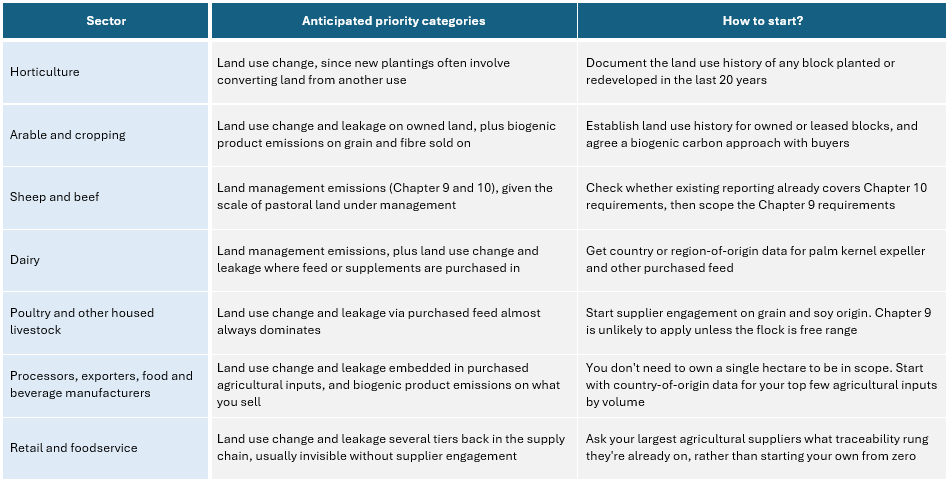
A business that doesn't farm, own, or control land isn't exempt. The Standard's scope extends to any business that purchases, consumes, processes, or sells significant volumes of food, fibre, feed, or other agricultural products, which puts most of the value chain in scope. The further you sit from the farm gate, the more your exposure concentrates in land use change and leakage via what you buy and biogenic product emissions via what you sell, while Chapter 9 and Chapter 10 tend to apply less directly to your own operations.\
Treat the table above as a starting hypothesis to test against your own inventory, not a conclusion. The actual answer depends on your specific systems and operations.
How do you approach traceability?
The single hardest and most valuable thing most businesses will build in response to this Standard is traceability, knowing where the land behind your inputs is located. The Standard doesn't treat this as pass or fail but instead sets out a ladder.
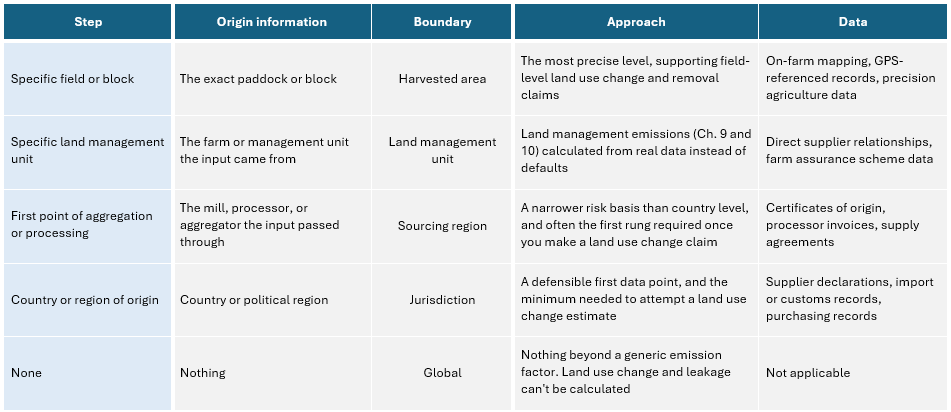
Businesses don't need to jump straight to traceability at field or block level. Starting at country or region of origin for your principal inputs is a legitimate, defensible first approach, and it's the prerequisite for any land use change or leakage calculation further up the chain. Climbing this ladder is realistically a multi-year exercise built on supplier engagement, not something that can be solved with a better internal calculation, so start engaging suppliers now.
Don’t forget that if your business carries material Forest, Land, and Agriculture (FLAG) emissions under SBTi, bring your FLAG target setting and your Land Sector and Removals Standard work into the same conversation. They draw on the same data and the same suppliers, so treating them separately means doing the traceability work twice.
How do you calculate the numbers?
Every category in the Standard follows the same basic approach as the rest of GHG emissions accounting: activity data multiplied by an emission or removal factor. What changes between categories is what the activity data is and the quality of the emissions factor that you're able to apply.
For land use change, the activity data is the area of land converted and when, and the factor is the carbon stock difference between the land's previous and current state. This is where your traceability rung matters directly. At country or region level, you're applying an average factor for that jurisdiction, which is conservative and defensible but not precise. At land management unit or field level, you can apply an actual, measured carbon stock change, which is far more precise but requires the supplier relationship and data to get there.
For land management emissions, activity data is largely the input and output data most agribusinesses already collect for existing reporting (e.g., fertiliser volumes and livestock numbers). However, calculating changes in the carbon stored within the land (Chapter 9) is different, since it requires either measured soil and vegetation carbon data or a modelled estimate, and few businesses currently have access to either.
For biogenic product emissions, the activity data is the volume of product sold or used that will eventually decompose or be burned, and the emissions factor is the carbon content of that product. The complexity here isn't the calculation. It's that most existing emission factor databases weren't built to isolate the biogenic CO2 component separately from the rest of a product's footprint, so sourcing or deriving the right factor is often the harder part.
How do you report against the Standard?
Reporting your GHG emissions in conformance with the Standard is a further, optional step, where you formally state your inventory meets the Standard's requirements and provide disaggregated reporting by category and subcategory, meaning you can't simply lump everything into one number. However, be careful about claiming conformance before you have the traceability and data to back it up. Otherwise, you risk making a public claim you can't fully support.
If the Standard is voluntary, you might wonder why your business should bother reporting against it at all. There's a commercial case for aligning early, separate from any regulatory driver. Customers, particularly larger corporates and exporters with their own Scope 3 targets, increasingly want confidence that suppliers can substantiate land sector claims against a recognised standard, and demonstrating that alignment can be a genuine point of difference in a tender or supply agreement. The businesses best placed to lead here are the ones that already hold reasonable data across their top few categories.
What to do now?
Don't wait for a perfect answer! The businesses that manage the Standard's impacts best will be the ones that treat the next reporting cycle as a data-building exercise, not a compliance deadline to meet at the last minute. Start by identifying how the Standard impacts your business and focus on the material areas that require uplift, whether that's building traceability for a handful of key inputs, closing a data gap on biogenic product emissions, or working out where your land management story splits between Chapter 9 and Chapter 10. And where there are actions you can't take yet, note why, and set a plan to get there.
If you'd like to talk through what the Land Sector and Removals Standard means for your business, please get in touch.