
Your financial auditor can sign off your GHG emissions… should they?
By Raedon Kane, Senior Sustainability Consultant, Oxygen Consulting
Published October 2026
Businesses seeking assurance over their greenhouse gas (GHG) emissions inventory increasingly have a choice to make between two different types of provider: a financial statement auditor, whose background is in auditing financial accounts, systems and controls, or a GHG assurance specialist, whose background is in GHG accounting methodology, emission factor selection and GHG emissions inventory preparation. Both are legitimate paths to a credible assurance opinion, and both are used widely across New Zealand and Australia. However, they each have different skill sets and assumptions, and understanding that difference matters before you engage either.
We've written this article to set out what a GHG assurance engagement involves, how the two types of provider compare, what to do when a regulation makes the choice for you, and how to work out which option is the better fit for your organisation.
What is a GHG assurance engagement?
A GHG assurance engagement is an independent check that the GHG emissions figures a company has reported are free from material misstatements and non-conformities and have been calculated using an appropriate, consistently applied method. The GHG statement being assessed could be an annual emissions inventory report, a climate-related disclosure, or a project's emission reduction claim. To be assured, it needs to be clearly identifiable and capable of consistent evaluation against suitable criteria.
The purpose of an assurance engagement is to give the users relying on those numbers (e.g., investors, regulators, customers, or a company's own board) confidence that the reported figures can be trusted. It is also one of the more effective tools against greenwashing, since a credible independent party has examined the basis for the claim, rather than taking it at face value.
What types of engagement are available?
There are three different types of GHG assurance engagements and knowing which one you're getting matters. These three types are:
Verification: assesses historical information, meaning emissions that have already occurred and been reported, such as a completed GHG emissions inventory for a past financial period.
Validation: assesses emissions from future activities (e.g., emission reduction target, project claim). As little or no actual data exists yet, validation relies on assumptions, estimation, and modelling rather than recorded activity data.
Agreed-upon procedures (AUP): involves no audit opinion and no assurance. Instead, the client and the practitioner agree in advance on a specific set of procedures to be performed, and the practitioner reports only on what was done and what was found, without expressing a conclusion. As no assurance is given, there is no assurance risk either, which makes this a useful, lower-cost option for organisations not yet ready for a full assurance engagement.
Any verification or validation engagement is also categorised as either a reasonable or limited level of assurance. Reasonable assurance is a high, though not absolute, level of assurance, and tends to be preferred where the statement will be used for significant decision making. Limited assurance involves gathering less evidence and results in a negative form of conclusion (i.e., nothing has come to the auditor's attention to suggest the statement is materially misstated) and tends to be preferred for a first-time verification or for inventories that rely on significant estimation. The level of assurance must be agreed before the engagement begins and cannot be changed partway through, unless the engagement is restarted.
Which standards apply in New Zealand and Australia?
GHG assurance engagements in Australia and New Zealand can be performed against a combination of international GHG-specific standards and jurisdiction-specific assurance standards. ISO 14064-3:2019 – Greenhouse gases – Part 3: Specification with guidance for the verification and validation of greenhouse gas statements provides an internationally recognised framework for the verification and validation of GHG statements and is commonly used for GHG assurance, particularly for voluntary engagements. However, for mandatory climate-related reporting, there are applicable assurance requirements determined by each country's regulatory and assurance framework.
For mandatory assurance of GHG emissions disclosures under the Financial Markets Conduct Act 2013, the Aotearoa New Zealand Climate Standards regime (NZ CS), NZ SAE 1 – Assurance Engagements over Greenhouse Gas Emissions Disclosures is currently the overarching standard that requires the assurance practitioner to apply either ISO 14064-3:2019 or ISAE (NZ) 3410 – Assurance Engagements on Greenhouse Gas Statements. A new standard, ISSA (NZ) 5000 – General Requirements for Sustainability Assurance Engagements, will also apply from 15 December 2026 and will provide a broader sustainability assurance framework for climate-related disclosures.
Australia has a broader sustainability assurance framework. For mandatory sustainability reporting under the Corporations Act 2001, including climate-related disclosures prepared under AASB S2 – Climate-related Disclosures, ASSA 5000 – General Requirements for Sustainability Assurance Engagements is the principal assurance standard while ASSA 5010 – Timeline for Audits and Reviews of Information in Sustainability Reports under the Corporations Act 2001 sets out the phased timing and extent of assurance required as mandatory sustainability reporting is introduced. For separate GHG statements required under the National Greenhouse and Energy Reporting (NGER) Act 2007, ASAE 3410 – Assurance Engagements on Greenhouse Gas Statements remains the relevant assurance standard during the transition to the broader sustainability assurance framework.
Do GHG assurance specialists also prepare inventories?
Some GHG assurance specialists are also inventory preparers, just not for the client currently being audited, as that would compromise independence. A sustainability consultancy typically spends significant time building inventories, designing methodologies, and advising clients on emission factor selection, alongside offering assurance services to organisations it has no preparation relationship with.
This means a GHG assurance specialist usually brings direct, practical insight into how inventories are built across various sectors, including where the judgement calls sit, which emission factor sources are defensible, how Scope 3 categories are typically bounded, and where the common errors occur. That is a different kind of expertise to general audit methodology, and it often shapes the auditor's recommendations toward improving the inventory itself, not simply confirming the accuracy and completeness of the calculations.
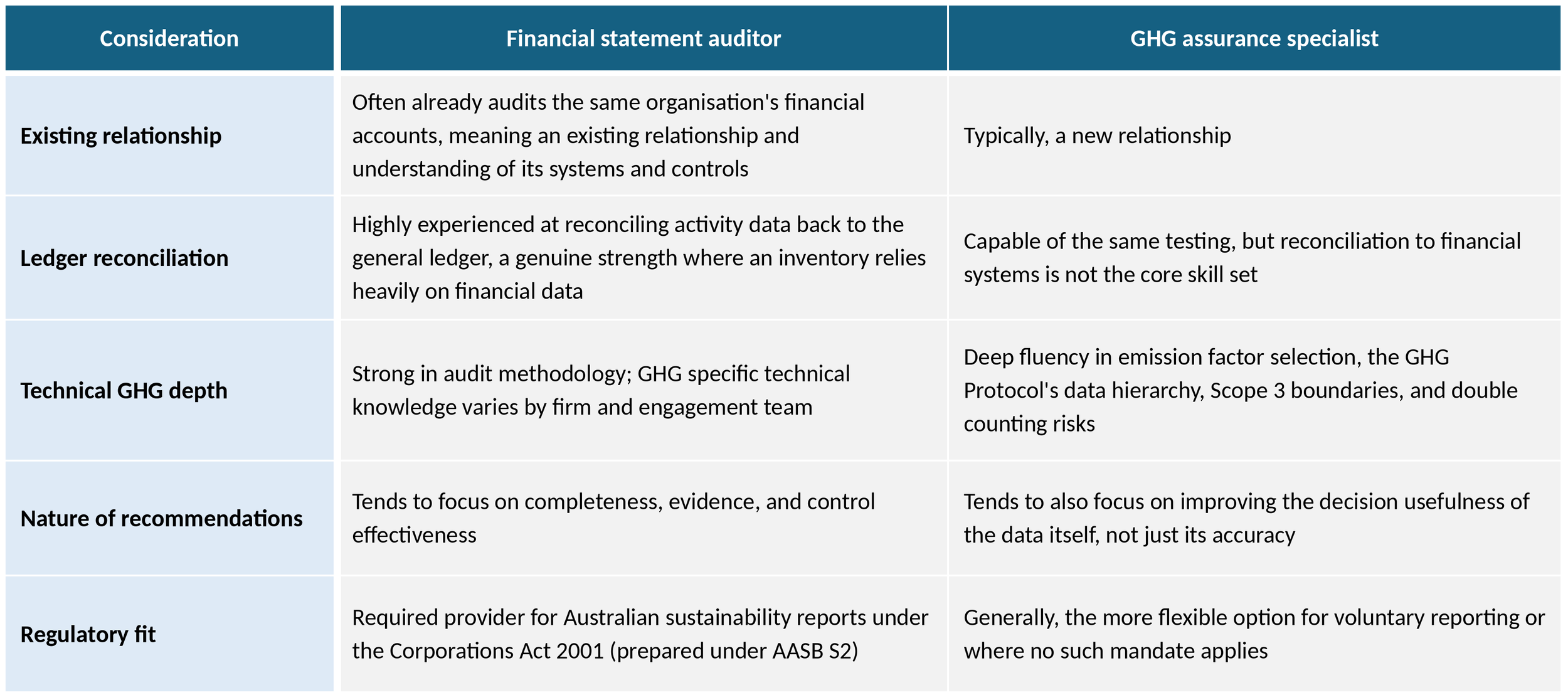
What does each type of provider bring to the table?
When choosing who you need for assurance over your GHG emissions, neither option is right or wrong. It all depends on who is the better fit based on what the inventory looks like and what the assurance needs to achieve.
A worked example: spend-based approach
A scenario that plays out in almost every Scope 3 GHG emissions inventory with the use of spend-based emission factors illustrates the differences between a financial statement auditor and a GHG assurance specialist’s approaches well. Within a spend-based approach, a company calculates emissions by multiplying spend by a relevant spend-based emission factor. This is a legitimate, recognised method under the GHG Protocol, though it sits at the lower end of the GHG Protocol's data hierarchy.
A financial statement auditor generally prefers this approach as the spend data can be reconciled directly to the audited general ledger, supporting its completeness and traceability. From a pure assurance perspective, spend-based data can be a stronger and more defensible starting point than an approach that is theoretically more accurate but relies on unverified, self-reported supplier-data.
A GHG assurance specialist is more likely to have concerns with this approach as spend-based data is a proxy for emissions rather than a measurement of them, and it does not reflect the actual emissions profile of individual suppliers. The practical consequence is that if spend is the only variable in the calculation, the only way to reduce reported emissions in that category is to spend less, which is not a meaningful decarbonisation lever. A business relying solely on spend-based data has no way of knowing whether switching to a less emissions intensive supplier has made a difference, because the method cannot detect that change.
Neither position is incorrect, as the financial statement auditor is correctly applying an assurance lens while the GHG assurance specialist is correctly applying a decision-usefulness lens. An increasingly recommended approach is to retain spend-based data as a baseline while the business progressively obtains supplier-specific data from the most material suppliers, which moves the method up the data hierarchy over time without requiring a full rebuild.
Do you always get to choose?
Businesses do not always get to choose their assurance provider as some regulatory frameworks specify who must provide the assurance.
In Australia, entities required to report under the Corporations Act 2001 must prepare a sustainability report that includes climate-related disclosures under AASB S2. The Act requires that report to be audited or reviewed by the entity's financial report auditor. An Australian entity in this regime will therefore receive assurance over its GHG emissions from its financial statement auditor, even where it has previously used, and been well served by, a GHG assurance specialist. These entities often still engage a GHG assurance specialist for pre-assurance support, such as a readiness review or an agreed-upon procedures engagement. The financial statement auditor may also draw on GHG specialists as experts within the assurance team.
New Zealand's NZ CS regime works differently as NZ SAE 1 does not tie assurance to a company's financial statement auditor. The External Reporting Board (XRB) has been explicit on this point, with NZ SAE 1 defining an assurance organisation broadly, covering sole practitioners, partnerships, companies or other entities of assurance practitioners. It is designed to allow any competent and independent assurance practitioner, financial or non-financial, to perform the engagement, provided the engagement leader has sufficient competence in both assurance and GHG measurement and reporting. The XRB has also consulted on a draft climate reporting roadmap that proposes replacing NZ CS with NZ IFRS S2, harmonised with AASB S2, with consultation having closed on 30 September 2026 and feedback now available. The draft roadmap leaves the assurance requirement unchanged, but full alignment with Australia would require financial statement auditors for climate reporting entities, removing the choice described above.
Otherwise, where no regulatory framework specifies who must provide the assurance, businesses are free to choose whichever provider best suits their needs.
What about accreditation and independence?
GHG assurance specialists and financial statement auditors operate under different professional and assurance frameworks, although both are subject to requirements designed to ensure competence, quality and independence.
GHG assurance specialists may be qualified through specialist programmes such as CEP Certified Carbon Auditor, which recognises competence in GHG accounting, auditing and verification. At the organisational level, GHG verification and validation bodies may also be accredited against ISO 14065, with ISO 14066 setting competence requirements for verification and validation teams. These frameworks are particularly relevant to GHG-specific and voluntary assurance engagements.
Financial statement auditors operate within established statutory and professional frameworks, supported by professional bodies such as Chartered Accountants Australia and New Zealand (CA ANZ). These frameworks include requirements covering auditor competence, professional conduct, independence, conflicts of interest and, in some jurisdictions, mandatory auditor rotation. Where financial statement auditors provide assurance over climate-related disclosures, they must also meet the applicable sustainability assurance requirements.
For both provider types, independence is fundamental. A GHG assurance specialist should not provide assurance where their involvement in preparing the GHG inventory creates an unacceptable self-review or other conflict, while financial statement auditors are subject to detailed independence requirements governing their audit and non-audit services.
When selecting a provider, it is therefore worth considering both the provider's GHG-specific competence and credentials, and the independence and quality controls supporting the assurance engagement.
What does this mean for cost, timing, and governance?
Engaging your existing financial statement auditor for GHG assurance can be efficient where they already understand your organisation, systems, controls and financial reporting processes. This existing knowledge can reduce the time needed to understand the business and establish the evidence trail, while also allowing financial and climate-related assurance to be coordinated through one provider. Larger audit firms may also have established governance, quality-control and review processes that provide consistency across engagements.
GHG assurance specialists offer a more focused delivery model, with teams specialising in GHG data, accounting methodologies and assurance criteria. Engagements are often delivered by smaller teams with defined procedures and timeframes, which can streamline information requests, review and completion. Their specialist focus and lower internal overheads can also make GHG assurance more affordable than engaging a larger financial audit firm, although fees will vary between providers and engagements.
There can be differences in timing and governance between providers. Larger financial audit firms may have more extensive internal review requirements and competing audit commitments, which can affect engagement timelines. Specialist providers may have fewer layers of review and greater scheduling flexibility, although this varies between providers.
The most appropriate approach will depend on the assurance requirements, inventory complexity, existing audit relationship, timeframe, governance expectations and level of GHG-specific expertise. When comparing providers, consider not only the fee, but also the proposed team, review process, key milestones, efficiencies and expected completion timeframe.
How do you choose the provider that suits your needs?
The following questions provide a practical framework for determining which approach is most appropriate for your organisation.
Are you subject to a regulatory framework that specifies who must provide assurance?
If so, and the requirements specify your financial statement auditor or another assurance provider, this will determine the available options regardless of the other factors below.Is your inventory relatively simple, consisting primarily of Scope 1 and 2 emissions and spend-based Scope 3 data that reconciles cleanly to your financial records?
If your primary requirement is independent confidence that the reported emissions are accurate and complete, a financial statement auditor, particularly one who already audits your accounts, may be an efficient and appropriate fit.Does your inventory include more complex Scope 3 categories, activity-based or supplier-specific data, or land-sector and removals accounting?
A GHG assurance specialist may be particularly well suited to these areas, where a deeper understanding of GHG accounting methodologies and sector-specific requirements can be important to the assurance process.Do you need recommendations that will improve your methodology, rather than simply confirm the existing numbers?
A GHG assurance specialist's experience across both GHG inventory preparation and assurance can provide valuable context and make this type of feedback more practical and substantive.Is this your first time seeking an independent check and are you unsure whether you are ready for full assurance?
An agreed-upon procedures engagement or pre-assurance readiness review with a GHG assurance specialist can help identify and address gaps before they arise during a formal assurance engagement.
What to do now?
Financial statement auditors and GHG assurance specialists bring different, complementary strengths, and organisations may use either provider, or both, depending on their circumstances and assurance needs. Rather than defaulting to the most familiar or accessible option, start by considering the nature and complexity of your inventory, what you need the assurance to achieve, and whether any regulatory requirements have already determined who can provide it.
From there, you can compare providers based on their relevant expertise, approach, independence, governance and quality controls, team structure, timeframe and overall cost. The right approach will depend on the specific needs of your organisation.
If you'd like to discuss which approach may be most appropriate for your business, please get in touch.